
Washington, IA – Monday, June 29, 2026 – After nearly four years of anticipation, advocacy, and preparation, America’s farmers finally have the clarity they’ve been waiting for.
The U.S. Department of Agriculture has released its technical guidance for integrating on-farm Carbon Intensity (CI) into the 45Z Clean Fuel Production Tax Credit. The Technical Guidelines for the Production of Regenerative Agricultural Biofuel Feedstock establish how regenerative farming practices can be measured, verified, and ultimately rewarded in the biofuels marketplace.
Continuum Ag welcomed the announcement, calling it a major milestone for farmers, biofuel producers, and the future of low-carbon agriculture.
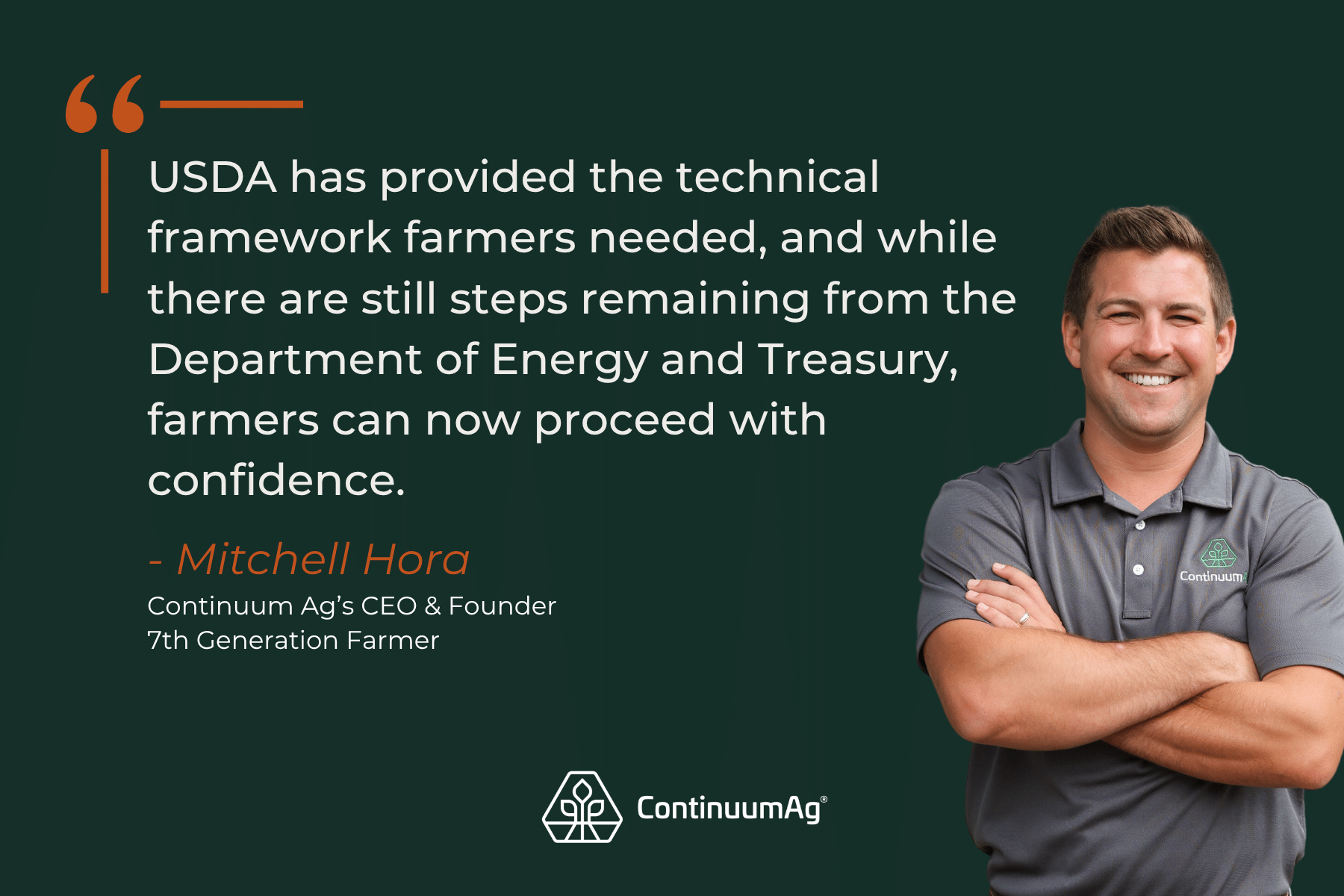
“First, I want to thank the administration for their continued efforts and support of farmers. This rule provides the clarity farmers and biofuel producers have been waiting for,” said Mitchell Hora, Founder and CEO of Continuum Ag. “We’ve spent nearly four years investing, building, and preparing for this moment. USDA has provided the technical framework farmers needed, and while there are still steps remaining from the Department of Energy and Treasury, farmers can now proceed with confidence.”
The USDA guidance outlines how field-level Carbon Intensity will be measured and verified for eligible feedstocks, including corn, soybeans, sorghum, and spring canola. The updated methodology calculates CI at the field level and rewards real farming practices that improve efficiency, while reducing emissions. Required data points include:
- Nitrogen application rates
- Cover crops
- Reduced tillage and no-till
- Approved nitrification inhibitors
- Manure utilization
- Yield
The guidance also establishes the measurement, reporting, and verification (MRV) requirements needed for feedstock carbon intensity reporting, providing farmers, elevators, and biofuel producers with a clear path forward. Continuum Ag created its flagship program CI Certification® to service this exact requirement.
While Continuum Ag continues to support future adoption of a book-and-claim system, the USDA guidance confirms a mass balance approach for feedstock traceability. This means that grain must move through the biofuel supply chain to qualify under the current framework.
“This guidance confirms exactly what information farmers need to collect and how that data will move through the supply chain,” Hora said. “This gives everyone, from farmers to grain elevators to ethanol producers, the ability to act upon the systems necessary to participate. We look forward to helping biofuel producers take advantage of this monumental opportunity and look forward to strengthening relationships amongst ag stakeholders.”
Continuum Ag held a press conference on Friday, June 26, to go through the new rules. If you missed it, you can watch the replay on our YouTube Channel: https://youtu.be/uNfHY5gBlBs