
By Mitchell Hora, CEO & Founder, Continuum Ag
Last week I had the opportunity to sit down with the White House Office of Management and Budget (OMB), alongside leaders from Treasury, and OIRA (the Office of Information and Regulatory Affairs), to discuss implementation of the 45Z Clean Fuel Production Credit. These conversations are critical — not just for biofuel producers or policymakers, but for farmers and rural communities who will ultimately determine whether 45Z succeeds or falls short.
I came to this meeting wearing multiple hats: as a seventh-generation farmer from southeast Iowa, as the founder of an agricultural software company that has CI scored hundreds of millions of bushels, and as an advocate for ensuring farmers are fully included in this once-in-a-generation clean fuels policy. Despite wearing multiple hats, I had a simple message; if you want 45Z to succeed, it has to allow farmers to participate and get an equitable share in the reward. I’ve put together for you in this blog more details about what I shared with our DC officials.
The 45Z Clean Fuel Production Credit is one of the most significant opportunities farmers have ever had to be rewarded for how they grow crops — not just what or how much they grow. Here’s what it means, why it matters, and what needs to happen next.
Why 45Z Matters to Farmers
Roughly 60% of a biofuel’s carbon intensity (CI) score comes from the feedstock — the corn, soybeans, or other crops used to make that fuel — and how those crops are grown. That means farmers control the single largest lever for lowering CI in the biofuel supply chain.
If implemented correctly, 45Z creates real demand for low-CI grain and turns agronomic decisions farmers are already making into new revenue opportunities.
How Farmers Create Value Under 45Z
Practices that can lower a farm’s CI score include things many farmers already do:
- Optimizing fertilizer rates and timing
- Reducing tillage or adopting no-till
- Improving yields with all sorts of innovations
- Using cover crops or other soil health practices
- Improving farm efficiencies
- Using field-level data, a farmer’s individual CI score can be calculated and verified. That CI score represents measurable emissions performance — and under 45Z, emissions performance is what drives value.
Across hundreds of millions of bushels already analyzed, the average farmer CI score is significantly lower than the federal baseline. That difference translates directly into tax credit value downstream.
What’s at Stake Economically and Why Feedstock Needs to be Included
After scoring about 400M bushels of US crop, we’ve found that corn farmers have reduced their CI by about 18 points from the Department of Energy baseline. An average CI improvement of 18 points equates to roughly:
- $0.40 per gallon of ethanol, or
- $1.08 per bushel of corn
At the national scale, that represents billions of dollars flowing through rural America. While the exact split of the shared value between farmers, biofuel producers, and other stakeholders will be determined by the market, transparency and fair value splits will be critical.
Why Book-and-Claim Matters
Farmers do not need to physically deliver their grain to a specific ethanol plant to create value. Under a book-and-claim system, the verified low-CI attribute of a bushel is tracked separately from the physical grain.
This approach:
- Avoids long-distance trucking and higher emissions
- Prevents disruption to livestock feed markets
- Allows more farmers to participate, regardless of location
- Matches how renewable energy credits and other federal programs already operate
Without book-and-claim, many farmers — especially those near livestock operations — would be effectively excluded from participating in 45Z. If you do not use book and claim it will create unfair advantages plus avoidable disadvantages for different types of farmers. Book and claim eliminates winners and losers and puts all farmers on an even playing field.
What Needs to Happen Next
For farmers to fully participate in 45Z, federal agencies must:
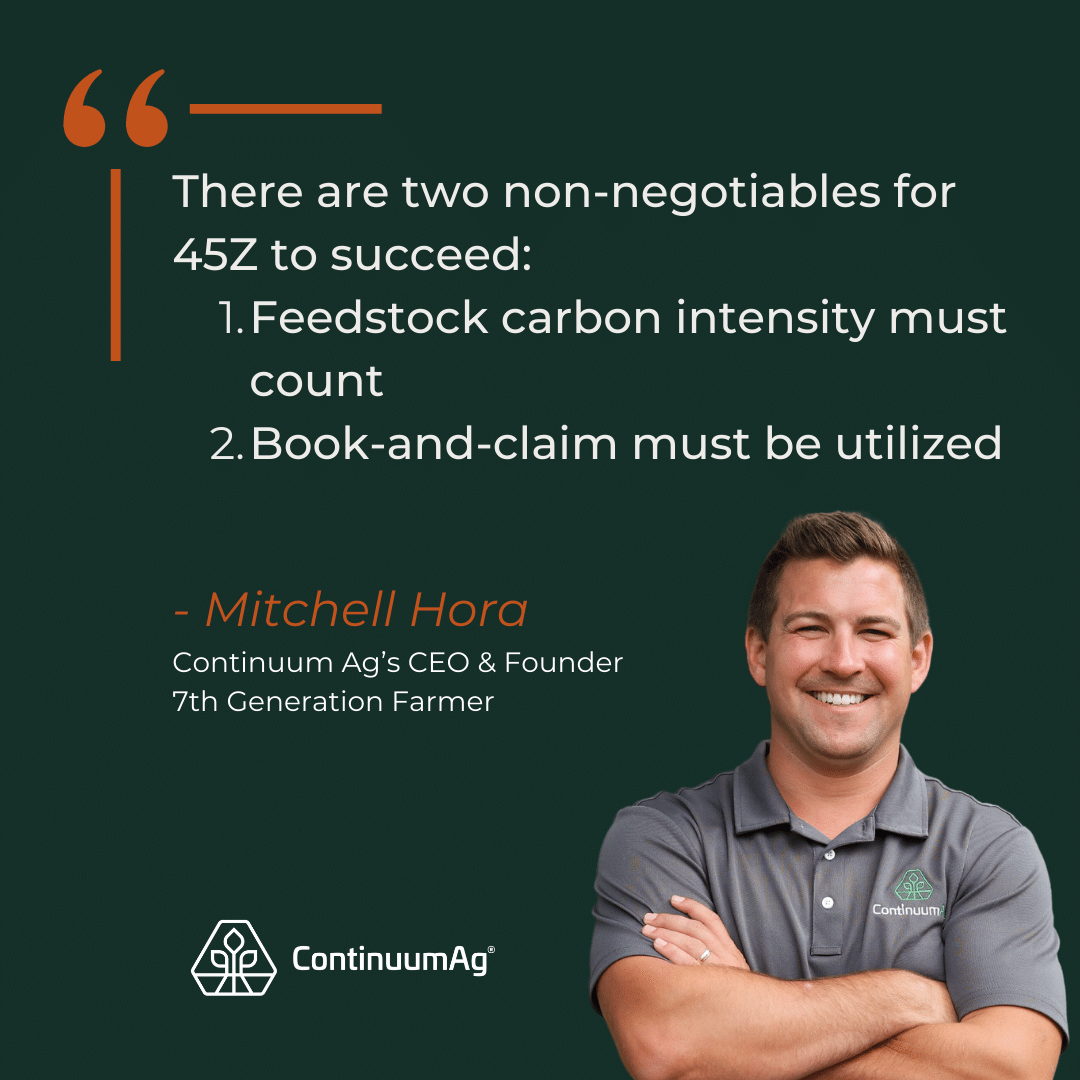
- Allow feedstock carbon intensity to count in the program
- Enable book-and-claim accounting across the supply chain
These systems already exist. The science is ready. The infrastructure is built.
Bottom Line
45Z has the potential to be the most impactful agricultural and sustainability program ever enacted — but only if farmers are included.
When farmer data is recognized, verified, and allowed to flow through the program, 45Z rewards real emissions reductions, strengthens domestic biofuel markets, and delivers meaningful economic impact to rural America.
Farmers are ready. The tools are ready. Now the rules need to catch up.
This was my message to the administration folks. They listened and will hopefully put our demands into action. Now we wait and hope that clarity comes soon.